You have created a stellar proposal and spent a week rehearsing and tweaking the script in your head. The day arrives and you feel you’ve nailed the presentation. A week later? Your proposal is rejected. What gives?
In “Change the Way You Persuade,” by Gary A. Williams and Robert B.Miller, they outline how understanding different decision-making styles can significantly enhance your ability to persuade.
The article categorises decision-makers into five distinct types: Charismatics, Thinkers, Skeptics, Followers, and Controllers. Each type processes information and makes decisions differently, which means that your approach to persuasion should be tailored accordingly.
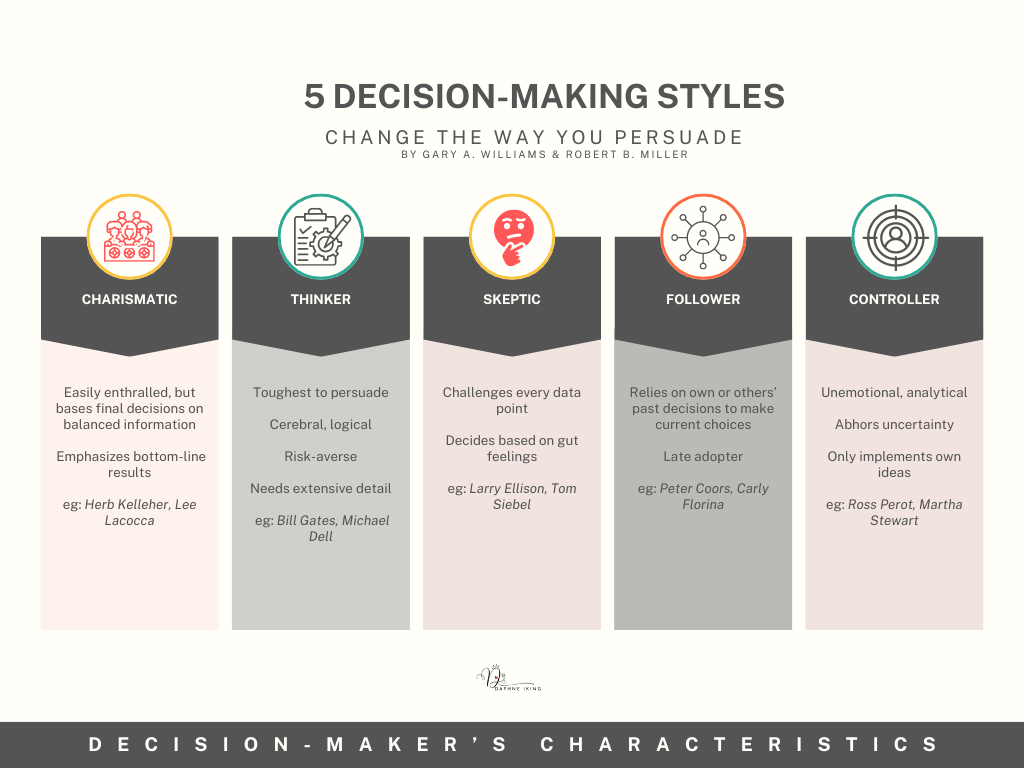

Conveying Context in Communication:
- Know Your Audience’s Decision-Making Style:
- Before communicating, identify which decision-making style your audience (or key stakeholders) falls into. For example, a “Thinker” needs data and logical arguments, while a “Charismatic” is more influenced by visions of the future and success stories.
- Application: By tailoring your context to match the decision-making style of your audience, you make your message more compelling and relevant, thereby increasing the likelihood of achieving your desired outcome.
- Tailor Your Message to Fit the Style:
- Structure your message to align with the specific style of your audience. If you’re addressing a “Controller,” for instance, you should be concise, focused on results, and emphasize control and predictability.
- Application: When setting the context in your communication, emphasize aspects that resonate most with the decision-maker’s style—such as risk management for Skeptics or innovation for Charismatics.
- Be Flexible and Adaptive:
- Stay adaptable in your communication approach. Be ready to shift your style if you realize that your audience has a different decision-making preference than you initially thought.
- Application: During your communication, observe the responses and cues from your audience. If they seem unengaged or skeptical, adjust your context and delivery to better match their decision-making style.
What next?
- Experiment: Think of people around you and try to identify their decision-style making. I’ve done this even with my children (and yes, I’ve had to shift my styles around especially for the 4 year-old boy!). Then practice a scenario where you can try to persuade different types of decision-makers. You can even level it up and try and prepare a brief context-setting introduction tailored to different people at your workplace or environment. Does the context and messaging change based on the decision-maker’s style? Did it work? How would you change things up?
By applying the insights from “Change the Way You Persuade,” you can learn to convey context in a way that is more aligned with the decision-making styles of your audience, making your communication more effective and impactful.
 Daphne Iking
Leave a comment